

The Man in the Tree — a short story
- Nick Edmunds

- Apr 17
- 12 min read
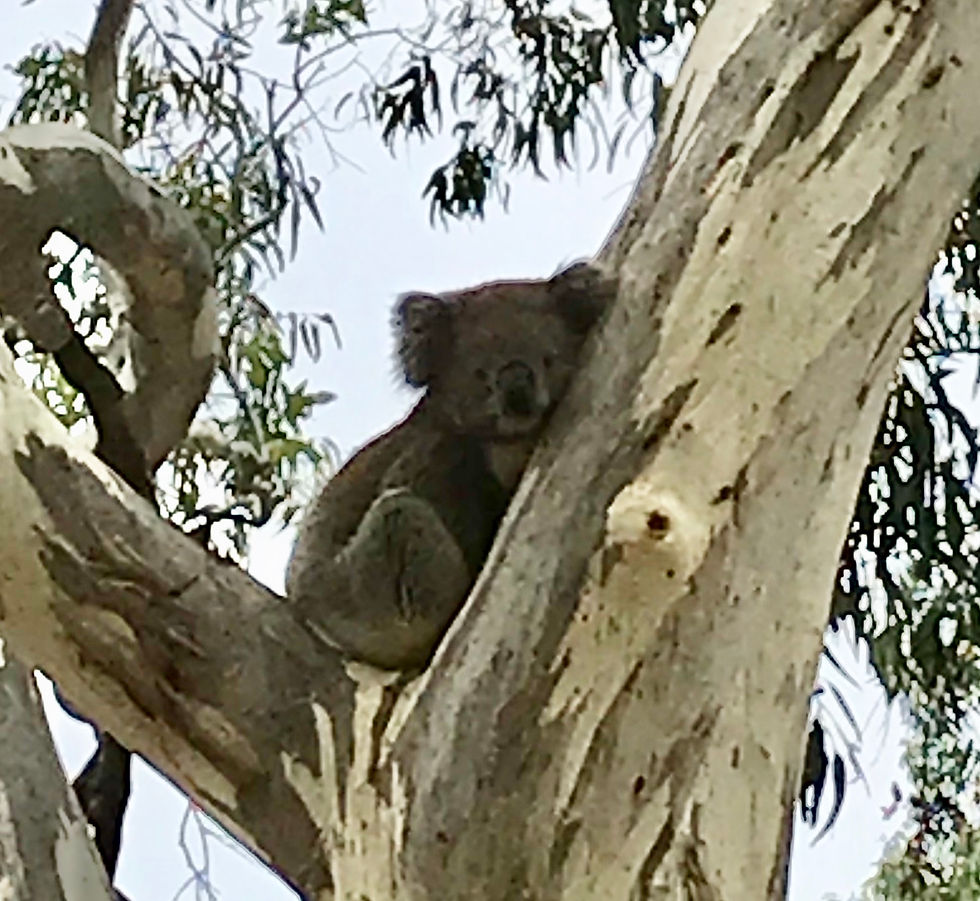
Hint: this is not Barry, it's one of the many pictures I took of a koala near Adelaide
Download a pdf copy of this story here
The Man in the Tree
A small crowd has begun to form, if three makes a crowd.
Two, in matching Merrell shoes and North Face, have paused, as I knew they would, on their way for their morning walk. I have seen them often, though never before from above. They were Him and Her at first, until I named them Howard and Hilda. Not that they look like the Howard and Hilda, but because they always go by at the same time, dressed as they are today, rain or shine. ‘Just in case,’ I can almost hear them saying, him to her or her to him, it doesn’t matter which, in their ever decreasing circle.
The other, younger and less lean, now stands beside them. When he isn’t looking up at me I can see for the first time he has a small bald patch, and from here his girth looks even bigger. He has a Bayne’s bag in his left hand and if he hadn’t stopped to gawp at me, by the time he passed my window he would have been eating the sausage roll. I wonder if he is hungry.
It is nice up here. When there’s a gust, the leaves make a sort of tussle-ussle-ussle sound, if you know what I mean. Not a rustle, more of a shiver with sound effects, though it isn’t cold up here. It’s warm, like it should be inside a living body. The air is thick with chlorophyll. At least I guess that’s what’s in my nose. Like sticking your face into a bunch of lettuce, but I’ve never done that, so I don’t really know. It would be different if the blossom were still out, though. I’d sneeze.
When the leaves part, I have a flicker of a view of my home, on the other side of the road and the burn. Sun reflecting from the window. From inside, across there, the tree looks different. Taller. It was as easy as I knew it would be, though, to climb up here. Grip that branch, then that one, swing yourself up. Just like I had worked out. Nae bother. And they thought I couldn’t even leave the house.
They’re talking now, pointing. Hilda’s shaking her head, looks surprised. Not surprised, more worried. Why? What’s wrong with being up a tree? Where else do they think I’m going to go? And what’s it got to do with them, anyway?
The young one just said ‘doacter’. What can a doctor do? The doc’ll be pleased when he hears I’m out. Even if it is just across to the tree.
The Relative
No one cares about him except me. He should be in somewhere, the nuthouse or somewhere. In my day he would have been carted off years ago. I’m too old to be bothered by this. Not that I really care what happens to him, like. But the neighbours go on about him all the time, like they think I should be doing something!
What can I do? I can’t take him in. Not that he would ever agree to it. And for God’s sake, I’m not even a real relative. Not my nephew, he was Jack’s, and now he’s gone. Not that he ever bothered.
But oh, yes, it’s me has to deal with it all. It’s not fair, at my time of life.
Still, I’ve done my bit now. Called the doctor. Not that anything ever gets done. But this time he’s gone too far. They’ll have to do something.
The GP
“A housecall? Up a tree?” I put the phone down before she wittered on any more. I’ll apologise later, or she’ll go in the huff again. She’ll give me all the emergency appointments this afternoon.
I had been looking after Barry for some years. The general consensus had always been that he had a problem, but if he did, I had never worked out what it could be. If it was a kind of madness, it wasn’t one that could be defined. That’s why the shrinks gave up on him. I only got them involved when the pressure to do something got too much. I had some amount of trouble getting them to see him at all, let alone at home. He was never a danger to himself or to anyone else. “I’m sorry, Doctor, it’s just that he doesn’t fit into our safety risk matrix”, or whatever bullshit they called it. I was waiting for them to say something like that.
Eventually they did go, a psychiatrist with a psychiatric nurse to hold his hand. Barry told me all about it the next time I visited him, when he had a throat infection. I had long given up trying to persuade him to attend the surgery. He said the two specialists were there more than two hours, asking him questions. He gave them ginger nuts and Irn Bru.
I received their letter about three weeks later; two and a half pages of the type of psychobabble they get away with writing. The only meaningful words I can remember from it were ‘tendency to reclusivity’ and ‘moderately obsessive personality’, but there was a definite tone of you’re wasting our scarce and valuable time, you thick-as-mince GP. The letter finished with, ‘ICD Classification: unclassifiable. No mental illness.’ Just like I told them in the referral. I even admitted I was only referring him to get the do-gooding busybodies off my back for a while. Of course, that’s not what I told his aunt.
‘A tendency to reclusivity’. Jeezuss H! He’s not a recluse. He never leaves his house, but he doesn’t avoid people. In fact he likes people visiting, shows them his drawings of the tree. He’s harmless. Gets his Asda home delivery every week, and never bothers anyone.
And now just because he’s up a tree someone wants him to have a housecall. So what if he’s up there? For years he’s been totally fixated on living in that fucking tree.
It’s not as if it’s bloody urgent. I’ll call in on him later on. He’ll be down by then, and back home.
###
There’s still a crowd of them staring up and pointing. Howard and Hilda have gone, but others have taken over, like they’re guarding me or something. Calling up at me all the time. I don’t want to get down. Why don’t they just get used to it, leave me alone. Spoiling my peace and quiet.
Ah, here he comes. He’s going quite grey, the doc. You see it even more from up here. Mind you, he must be getting on a bit. Been here as long as I can remember.
“Oh, hiya, Doc! How’re you doin’, pal?”
“Are you going to come down, ya daft bugger?”
“No.”
“Why’ve you got yer big winter coat on? It’s July, man.”
“I thought it might get a bit cold overnight.”
“You can’t stay up there, Barry, you’ll fall out, hurt yersel.”
“It’s OK, Doc, I’ve thought of that. Planning, y’know. Got everything I need in my rucksack, see. Goin’ tae tie mysel round the branch later on.”
“Ach, Barry, for God’s sake, man.”
###
Barry was still up in the tree the next day, and a social worker called the surgery to say it was a disgrace the doctor hadn’t done something. Someone had already called the police, and then the Fire Brigade had tried to persuade Barry down. So I had to do another housecall.
Looking up from under the tree, once the crowd’s muttering had quietened I called, “C’mon, Barry. You’ll need to come down. What the hell are you doing when you need the toilet?”
“I telt ye I’d thought o’ everythin’, Doc.” Barry waved his two litre Fanta bottle. “I empty it at night when no one’s going to get wet. It’ll do the grass good.”
“Aw, c’mon! What about—the other?”
“I’ve got these,” said Barry, waving a roll of dog poo bags. “Another one hanging in the bushes now and then’ll not be a problem.”
“Aw for f… I mean, for pity’s sake, Barry. Get down, man.”
###
When Barry had spent two nights in the tree, and was still showing no sign of coming down, someone called the local paper. I saw a picture in the Wednesday edition, a blurry image of a figure clinging to a branch as five or six onlookers all looked up at him, pointing. The crowd was even bigger the next day, and a national newspaper carried the story. Word of the man in the tree soon spread, and people from outside the village began to come for a look. A few neds from neighbouring villages came to throw things at him, but were soon chased away by a growing band of fans. Takeaway vans lined up on Upper Mill Street to serve the swelling transient population of Tillicoultry.
It was when someone posted about Barry on Instagram that things really took off. Barry had his own page, @BarryTreeMan, run by an influencer. His following grew to the point where TV news programmes began to take notice.
Gifts began to arrive for Barry, and a team of survivalists turned up. I remember thinking the original intention of their camouflage outfits was a bit spoiled by luminous yellow lettering: ‘Barry’s Team’. Soon he had a two-roomed tree house, hewn from sustainably grown local timber and with an Elsan toilet. A pulley system delivered Barry’s supplies and took away his recycling.
The next development was electricity on tap. With the help of the most bizarre supporting letter I had ever agreed to write, The Council had agreed to divert the domestic supply to Barry’s cottage across the burn. It took them two days to route the cable under the road and across the bridge, but Barry now had a state of the art fuse box and more sockets than he could use.
Environmentalists formed a large faction of his supporters, perhaps drawn to the tree rather than to Barry. Placards began to appear reading, ‘Be Like Barry—Save the Planet’, and a stall selling merchandise was set up beside the burn. A rota of happy volunteers guarded Barry and his tree, controlling access to the area and marshalling crowds. The growing number of visiting news outlets from around the world were kept at a respectable distance. Colourful knitwear was delivered from Canada, Japan and Switzerland, but there was far too much for his own needs, and most was donated to The Gate Charity. A woman from Phoenix, Arizona proposed to Barry.
Everyone wanted a piece of him. The initial tabloid splashes rippled out far enough to reach the broadsheets; whimsy morphed into serious sociological debate. Questions were raised about homelessness, mental health care provision, and local authority budgets. Lawyers, planners, historians, anthropologists, and philosophers took up Barry’s cause, or railed against it. Petitions calling for Barry’s Law met the thresholds that meant both parliaments could dither and wring hands. Neither seemed able to agree on what it was intended to rule on.
Barryanity, as it was soon known, had a positive, unifying effect which spread far and wide. World leaders, and celebrities visited, accommodated in an adjoining guest suite built onto Barry’s treehouse. One viral video showed Barry looking sheepish as the Dalai Lama shook both his hands and drew him forward to gently touch foreheads. I remember one of the sneering London news rags called the greeting the Tillicoultry version of the Glasgow kiss. Typical.
As the birthplace of a spiritual and sociopolitical movement, Tillicoultry swelled in importance and size. Major charities and peace foundations established hubs, and new hotels sprang skywards. A band called The Barrymen, whose founder and lead songwriter claimed to be a reincarnation of John Lennon, had a permanent residency in the Devonvale Hall, around which grew a vast entertainment and leisure park, dubbed Tillivegas.
Six Years Later
On a hectic Tuesday after one of the two new eqinoctial public Barrydays, I was asked to visit Barry. ‘A personal matter’ was the only detail his manager had given. I only had a time for a hurried assessment, but Barry needed to talk. Late that evening I made a return visit on my way home.
I was tired and hungry, impatient while the lift descended from the treehouse. I had to stand aside to allow a crate of ‘Blessed by Barry’ merchandise to be wheeled out. The waiting van bore decals on each side, a flattering artist’s impression of Barry’s face above a stylish tree logo.
I was shocked by how low Barry’s mood was. I had to take things slowly, probing gently before Barry managed to open up. All he managed was, “I didn’t want any of this.”
We had several sessions over the coming weeks. I knew no medication or psychotherapeutic intervention was going to help. Barry was trapped by unwanted fame and commercial interests, and would only get worse if he didn’t escape.
There was resistance, of course. Barry’s manager was furious. “Think of your fans, Barry. Followers, I mean. Pilgrims are due to arrive from Africa and Mexico, and that’s only this week.”
Barry was able to stand his ground. With an end to it all in sight, he seemed to gather new strength. He did make one concession to his manager, and when he took the lift down from his tree he wore a simple white gown over his Wrangler jeans and Motorhead hoodie. He kept his head and face covered, of course.
I accompanied Barry on his walk home, 150 yards from tree to council house. The news coverage was wall-to-wall, with comparisons made to Gandhi’s famous Salt March and Nelson Mandela’s walk to freedom. Drone footage I saw later on Sky News reminded me of watching the O J Simpson convoy.
However, I could soon see that Barry had little chance of returning to a normal life. Press harrassment and pressure from hangers on persisted. After a day or two he retreated back into himself, even further, shunning all callers except his Asda delivery driver. Ironically, he had become reclusive. I was lucky he allowed me to visit, although he barely spoke, staring blankly at me in response to gentle questioning.
On one of these depressing visits, a few months after he had returned to his house, I was staring out through Barry’s living room window, at a loss for what to say next. A merch crate was passing, and Barry’s aunt was giving press interviews from her chauffeur-driven Range Rover. Barry surprised me. He stood up to look at the scene outside. When he turned back to me, he was shaking his head, his hands fisted.
Through gritted teeth, he said, “For fuck's sake, Doc! All I wanted to do was live up a tree.”
“We’ve got to get you out of this, Barry.” We came up with a plan.
Barry played his part like a seasoned actor. The next morning, I was back with him when he told his manager he was returning to the treehouse. He was better, he said, and wanted to continue his good works. On the walk back to the tree I was embarrassed by the TV cameras and crowds, but Barry moved with confidence. Still with his face obscured and his head down, as he strode beside me he leant in close, muttering sotto voce, “We can do this, Doc.”
The team looking after Barry were ecstatic. A press release heralded the return of a refreshed and envigorated Barry, who was relishing the opportunity to spread the wisdom he had gained in his self-imposed spiritual exile. He expressed sincere gratitude for the prayers and support of his followers. Shares in the Barry Corporation rose sharply, and his re-emergence led to a spike in prices for flights to Cumbernauld Airport, a growing transport hub some wished to rename Barry International.
Rumours spread that the first photograph of Barry might be released. Until now, the only image in circulation had been a computer generated impression made from his primary school class photo. Speculation grew in the media that Barry’s voice might soon be heard, and some even predicted that one day he would make a live appearance on screen.
Three days later Barry disappeared.
There was a massive hunt for the troubled guru. Some thought Barry had been kidnapped, others that he had been murdered by the Russians or the Chinese. Appeals were made to the Dalai Lama, the Pope, and various Presidents, who all issued prayers for Barry’s safe return. It seemed everyone would always remember where they were when they heard Barry had gone.
Myths grew: he has gone to Blackpool for 40 days and forty nights; he has been taken up by a higher power; he will return in the form of a guiding spirit on every person’s shoulder; he has sacrificed himself to save mankind.
But Barry was never again seen in Tillicoultry.
Two Years Later
As had happened several times a day since I retired, my thoughts turned to the evening Barry disappeared. It had been his idea to hide himself on a trolley piled high with cardboard boxes. There had been a delivery of merchandise, and the empty cartons were due to be collected and returned to the distribution centre. It was easy for me to distract the duty attendant with idle chatter, while Barry slipped into the boot of my Saab.
Bringing myself back to the present when the theme to Newsnight started, I creaked myself out of the chair.
“It’s Monday, I’d better go and put the recycling out.”
“You’re obsessed with those wheelie bins,” said my wife.
We kept the bins in a corner of the garden, concealed behind a tall beech hedge I had planted 30 years ago. It was a clear, dry night, not too cold, and after standing for a while breathing in the scents of the garden, I looked up into the dense evergreenery of an old yew tree.
“G’night, Barry,” I whispered.
“’Night, Doc!”
© N J Edmunds
March 2026
Nick Edmunds was a GP in Tillicoultry, but he never had a patient called Barry who lived in a tree.
This story was first published in Issue 116 of iScot Magazine
© N J Edmunds


Comments